"The Indian River Lagoon has been here for thousands of years — long before Florida was a state, long before Europeans arrived. The people who lived along its shores for thousands of years understood it intimately. They built their lives around its rhythms, its seasons, and its abundance. Understanding that history helps us understand what the lagoon once was — and what we're trying to restore it to."
The Lagoon's Ancient Past
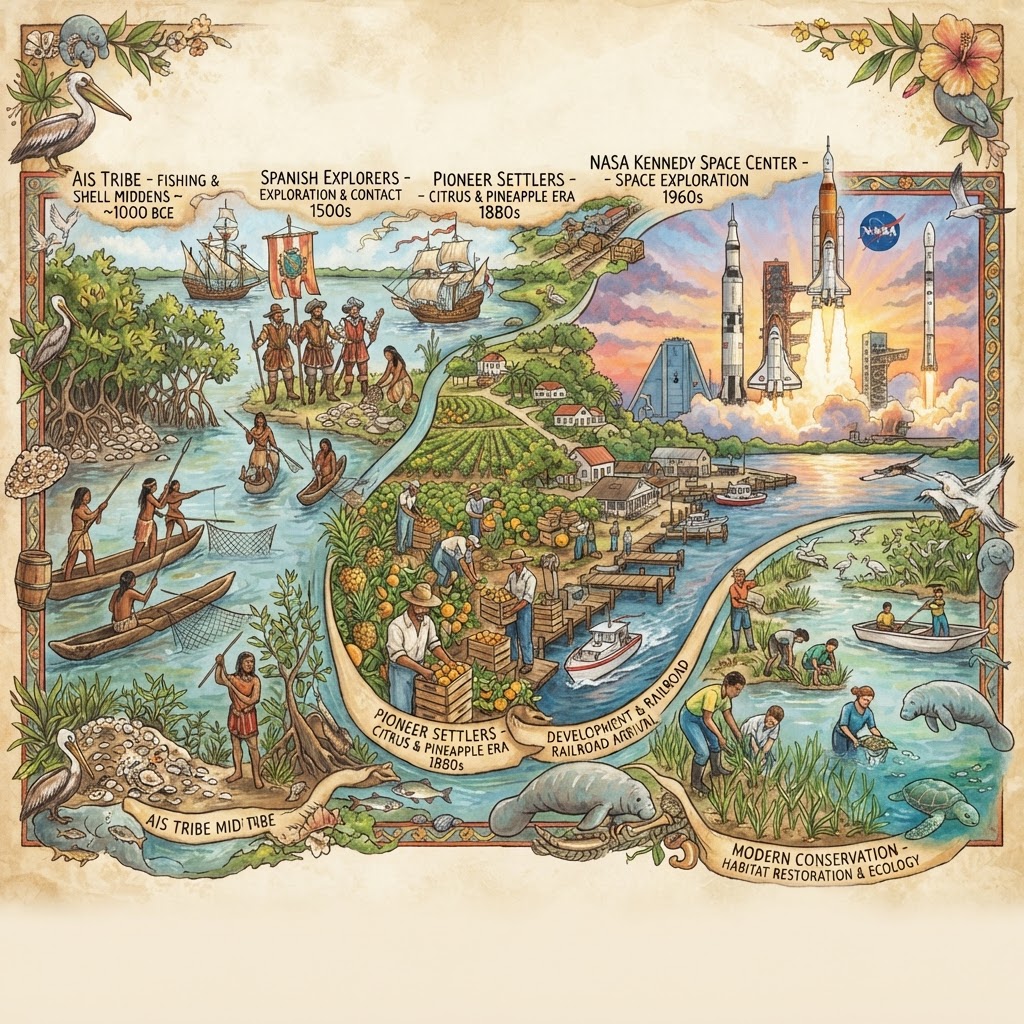
The Indian River Lagoon's human history begins at least 12,000 years ago, when the first Native Americans inhabited the Florida peninsula following the retreat of glaciers from North America. Sea levels were significantly lower at this time — the lagoon as we know it did not yet exist. As sea levels rose over thousands of years, the modern lagoon system gradually formed. By approximately 2,500 years ago, a rich estuarine ecosystem was well established. Indigenous peoples of the IRL: the Ais (pronounced AY-iss) people were the dominant inhabitants of the central and south Indian River Lagoon region for at least 2,000 years before European contact. The Ais were expert fishers and shellfish harvesters who possessed intimate ecological knowledge of the lagoon system. Evidence of their presence: massive shell middens (mounds of discarded shells) remain visible at sites throughout the IRL corridor — these middens are essentially ancient refuse piles that provide an archaeological record of diet and culture; oyster shells are most common, along with clam, whelk, and various fish bones. The middens also served as elevated habitation sites above the flood-prone shoreline. Other groups: to the north, the Timucua people occupied the area around present-day Volusia and northern Brevard counties; to the south, the Jeaga and Tequesta peoples inhabited areas from the St. Lucie area to Miami. European contact and collapse: Spanish explorers first encountered Florida's east coast in the early 1500s (Juan Ponce de León, 1513); within 200 years of sustained contact, the indigenous population of Florida was essentially exterminated — not through military conquest alone, but primarily through epidemic diseases (smallpox, measles) to which they had no immunity; by 1750, the Ais people as a distinct culture no longer existed.