
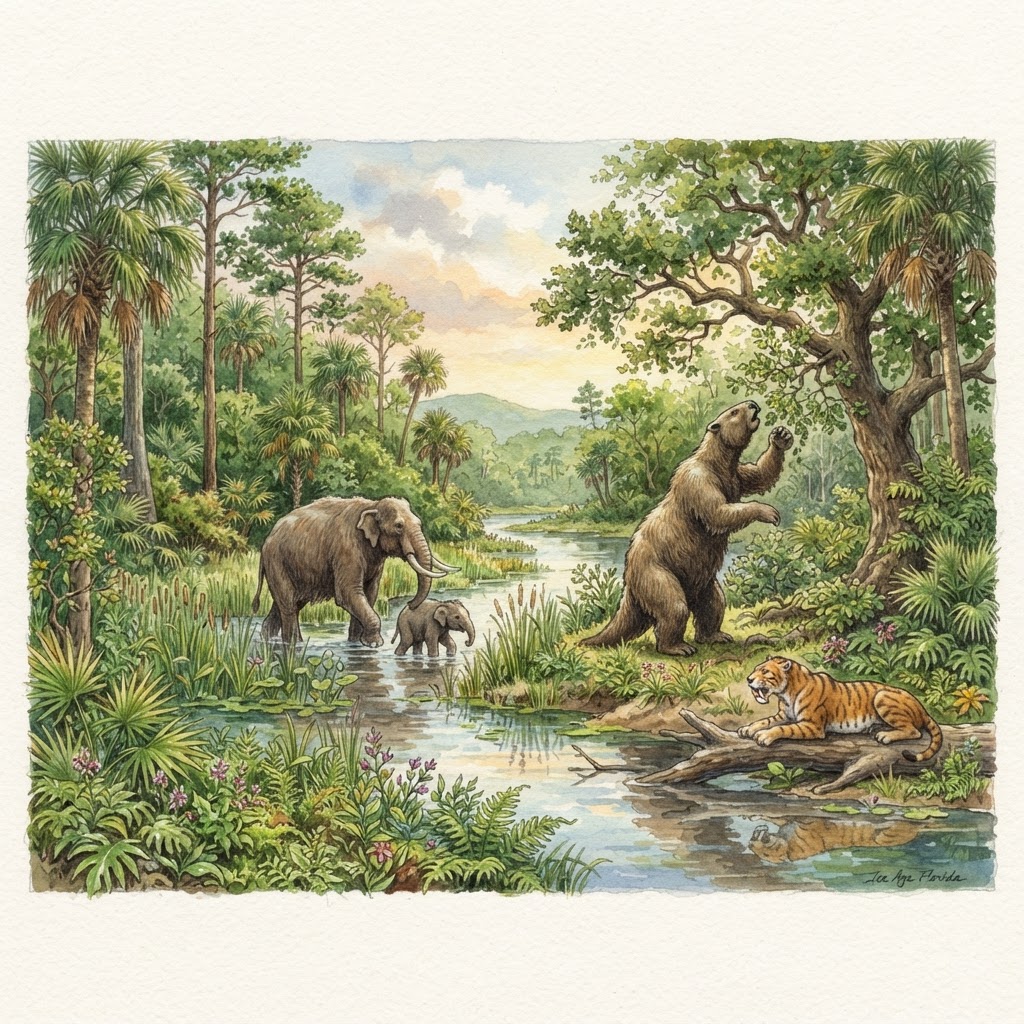
"The 'Ice Age' wasn't one event — it was a whole epoch called the Pleistocene, lasting from 2.6 million to about 11,700 years ago. During this time, giant ice sheets covered much of North America and Europe. Florida wasn't covered in ice — but it was much cooler, much drier, and home to very different animals than today."
What Was the Ice Age?
The 'Ice Age' commonly refers to the Pleistocene epoch, which lasted from approximately 2.6 million to 11,700 years ago. During the Pleistocene, Earth experienced repeated cycles of cooling and warming — 'glacial' periods, when enormous ice sheets covered much of North America, Europe, and Asia, and 'interglacial' periods, when the climate was warmer and the ice retreated. At the peak of the last glacial period, about 20,000 years ago, ice sheets up to two miles thick covered Canada and the northern United States, reaching as far south as New York and Ohio. Florida was never glaciated — it was too far south — but it was dramatically affected: temperatures were cooler, rainfall patterns were different, and sea levels were much lower. The Pleistocene was the age of the megafauna — the large mammals like mammoths, mastodons, giant sloths, and saber-toothed cats. It was also the epoch when humans first arrived in the Americas, at least 14,000 years ago. The Pleistocene ended about 11,700 years ago, when the last glacial period ended and the modern, warmer Holocene epoch began.