"Before there were any bridges, how did you get across the Indian River Lagoon? The answer is: you didn't, unless you had a boat. For decades, ferries and flatboats were the only way to cross. The lagoon was a barrier as much as a highway — and that shaped everything about where people lived."
The Lagoon's First Crossings
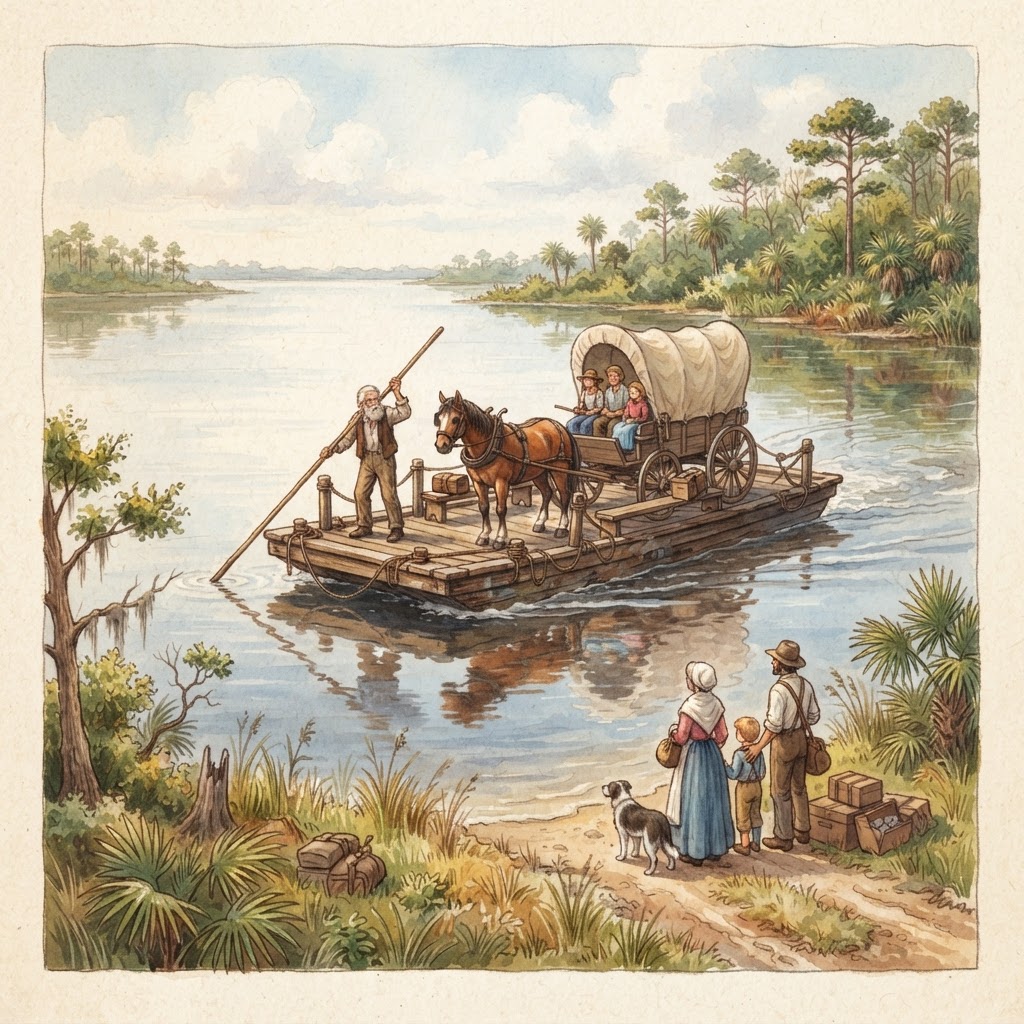
The first crossings of the Indian River Lagoon: When the first settlers arrived along the Indian River Lagoon in the 1800s, there were no bridges across it at all. The lagoon — a long, narrow estuary running roughly north–south — separated the mainland from the barrier islands and Merritt Island. For decades, the only way to cross was by boat. Ferries: Small flatboat ferries operated at a few points along the lagoon, carrying people, wagons, and livestock across. These were often informal — a landowner with a flatboat who charged a small fee to carry travelers across. The ferries were slow, limited, and weather-dependent. You couldn't just drive across; you had to wait for the ferry, and crossings were limited by the boat's capacity. The lagoon as a barrier: Because crossing was hard, the mainland and the barrier islands/Merritt Island developed as separate worlds. Most early settlement was on the mainland (the western shore), where the towns like Titusville, Cocoa, Rockledge, and Eau Gallie grew up. The barrier islands and Merritt Island were sparsely settled — fishing camps, citrus groves, and a few homesteads. This ferry era lasted from the first settlement in the mid-1800s until the first bridges began to be built in the late 1800s and early 1900s. The first bridges would change everything — connecting the mainland to Merritt Island and the barrier islands, and opening up new land for development.