
"Before you can explain algae, you have to explain water movement. How fast water flushes through the lagoon decides how long nutrients stick around — and how bad a bloom can get."
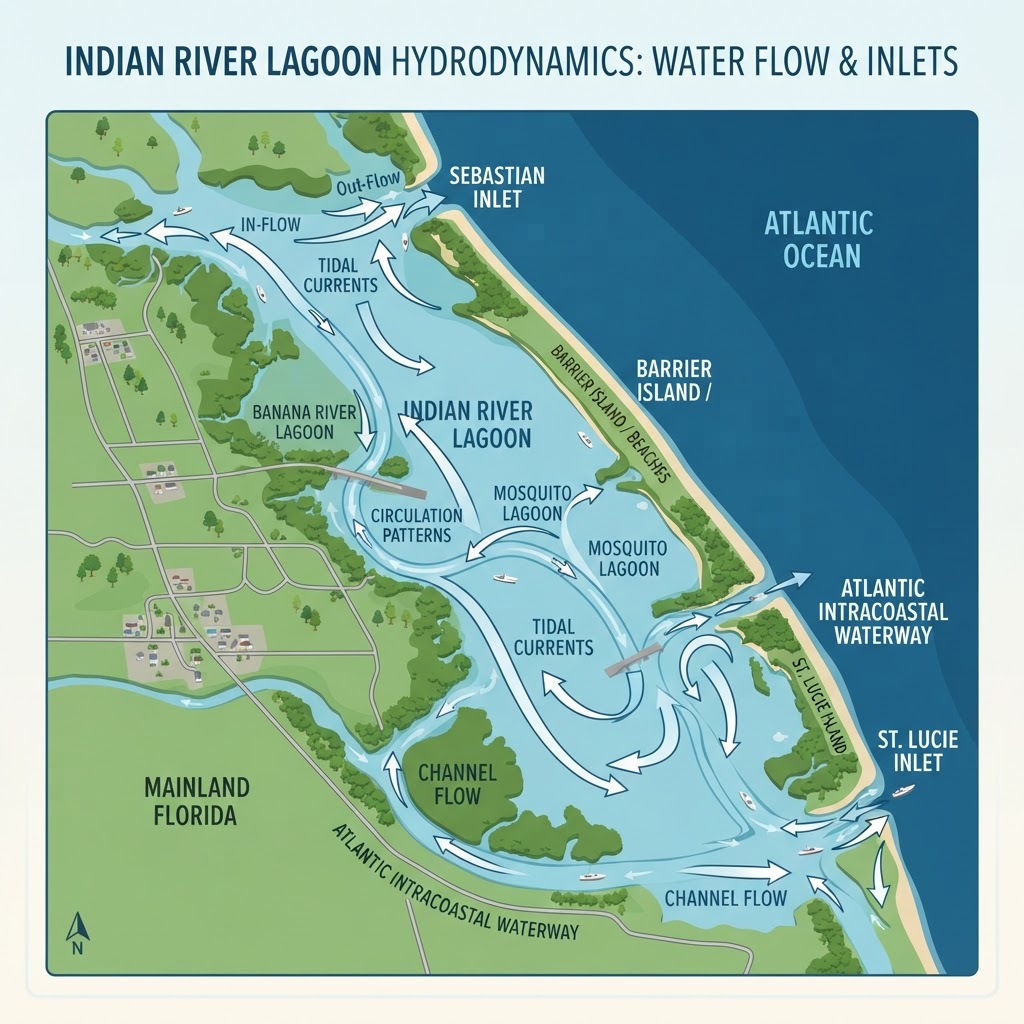
Why Hydrodynamics Drives Water Quality
Hydrodynamics — how water moves, mixes, and exchanges — is the physical engine underneath every water-quality process. The Indian River Lagoon is a bar-built estuary with limited ocean exchange through inlets and weak tidal flushing in its upper reaches. Residence time (how long a parcel of water stays in the system) ranges from days near inlets to months in the back lagoon and dead-end canals. Long residence times let nutrients accumulate, algae bloom, and dissolved oxygen crash; short residence times flush problems out before they develop. You cannot interpret a chlorophyll or nutrient measurement without knowing the hydrodynamic context of where it was taken. Hydrodynamic monitoring is therefore the foundation of any water-quality assessment — it tells you whether a high reading is a local problem or a whole-system condition.