
"Managers can't run experiments on the whole lagoon — too big, too slow, too risky. So we build a digital lagoon, test the fix there first, and only act in the real one when the model says it'll work."
Why Model Ecosystems? Predict Before You Manage
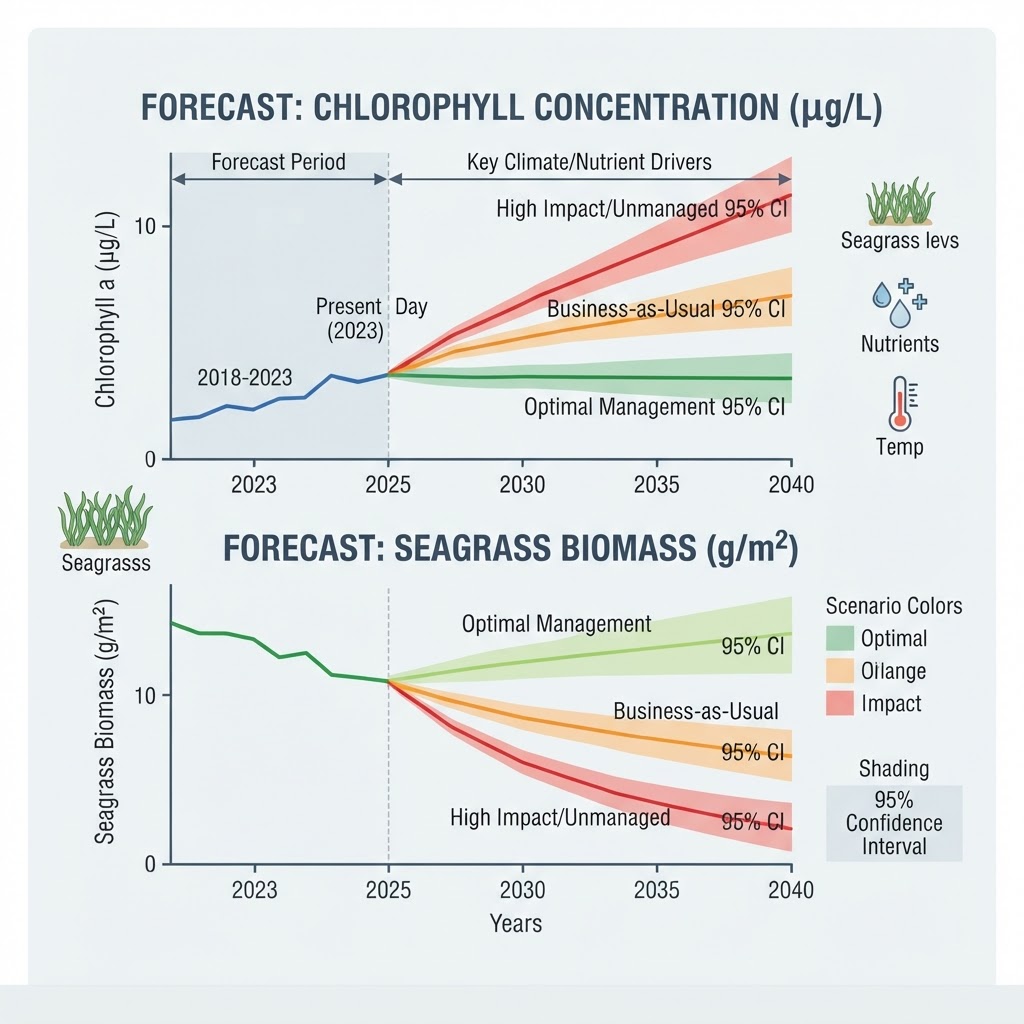
Ecosystem modeling is the science of prediction. A model is a formal, mathematical representation of how the system works — how nutrients drive algae, how algae consume oxygen, how seagrass responds to light. Once built, a model lets us ask 'what if' questions that cannot be tested in the real lagoon: what if we cut nitrogen loads 30%? What if temperatures rise 2°C? What if we restore a seagrass meadow here? The alternative — manipulating the real estuary to see what happens — is too slow, too expensive, and often unethical. Models are therefore the primary tool for evaluating management options before committing resources, for forecasting responses to future conditions (climate, population growth), and for integrating understanding across chemistry, biology, and hydrodynamics. A useful model is never 'true' — it is a purposeful simplification whose predictions carry stated uncertainty.