"We talk endlessly about nitrogen, but carbon runs the show too. Carbon is the food, the fuel, and — locked in the mud — the climate connection. Estuaries are some of the most carbon-active places on Earth."
Carbon in Estuaries: The Hidden Currency
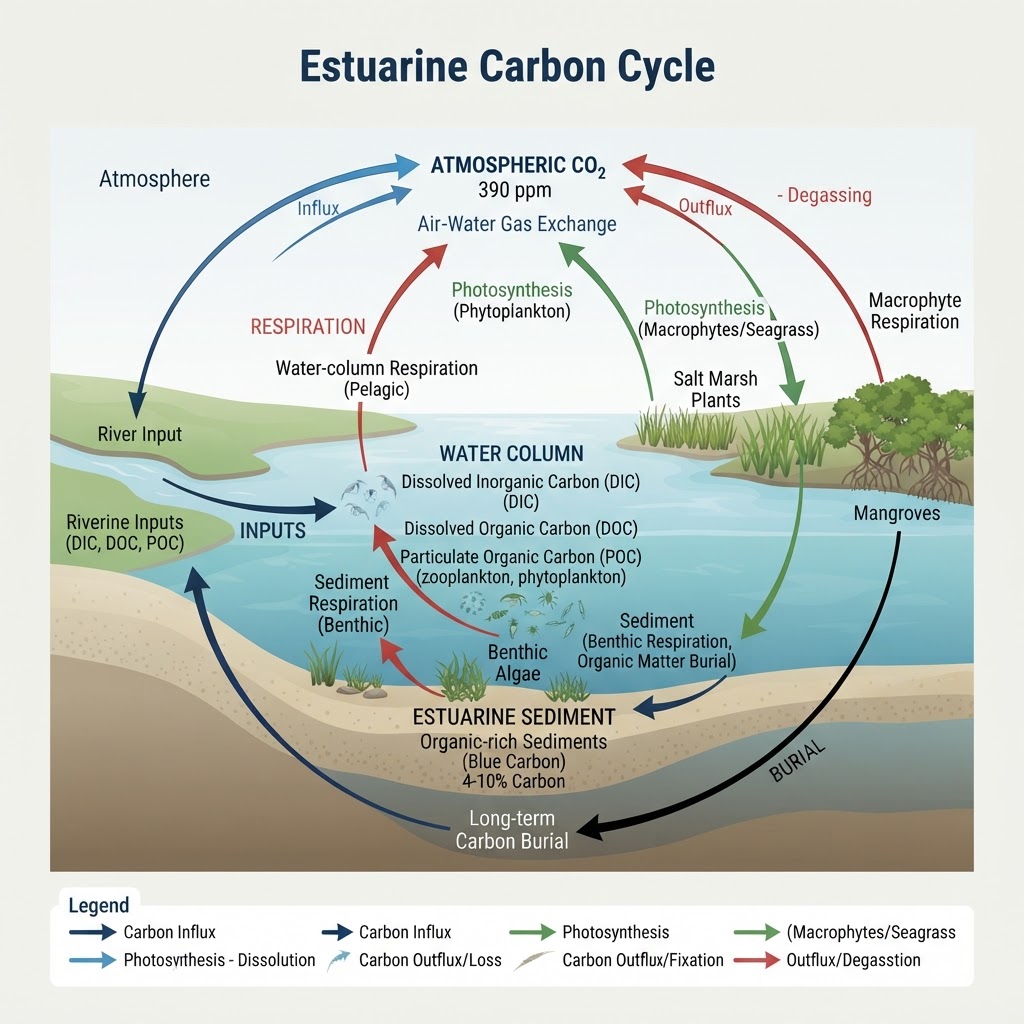
Carbon is the currency of life: every organism is built of it, every metabolism moves it. Estuaries are exceptionally carbon-active systems because they sit at the junction of high primary production (seagrass, mangroves, marshes, phytoplankton) and high organic loading from their watersheds. The estuarine carbon cycle has three master flows: fixation (photosynthesis converting CO2 to organic carbon), respiration (organic carbon oxidized back to CO2 by plants, animals, and microbes), and burial (organic carbon sequestered in sediments for decades to millennia). The balance of these flows determines whether an estuary is a net carbon sink (storing more than it releases) or a net source (releasing more than it stores). Unlike nitrogen, carbon has a direct climate dimension: the buried fraction removes CO2 from the atmosphere, while the respired fraction returns it. Understanding estuarine carbon cycling is therefore both an ecosystem-health question and a climate question.