"Long before Cocoa Village had shops and cafes, it was just a rough little riverfront settlement on the Indian River Lagoon. A few families, a dock, some cabins in the pine and palmetto scrub. That's all it was for decades. But the lagoon was right there, and that meant it had a future."
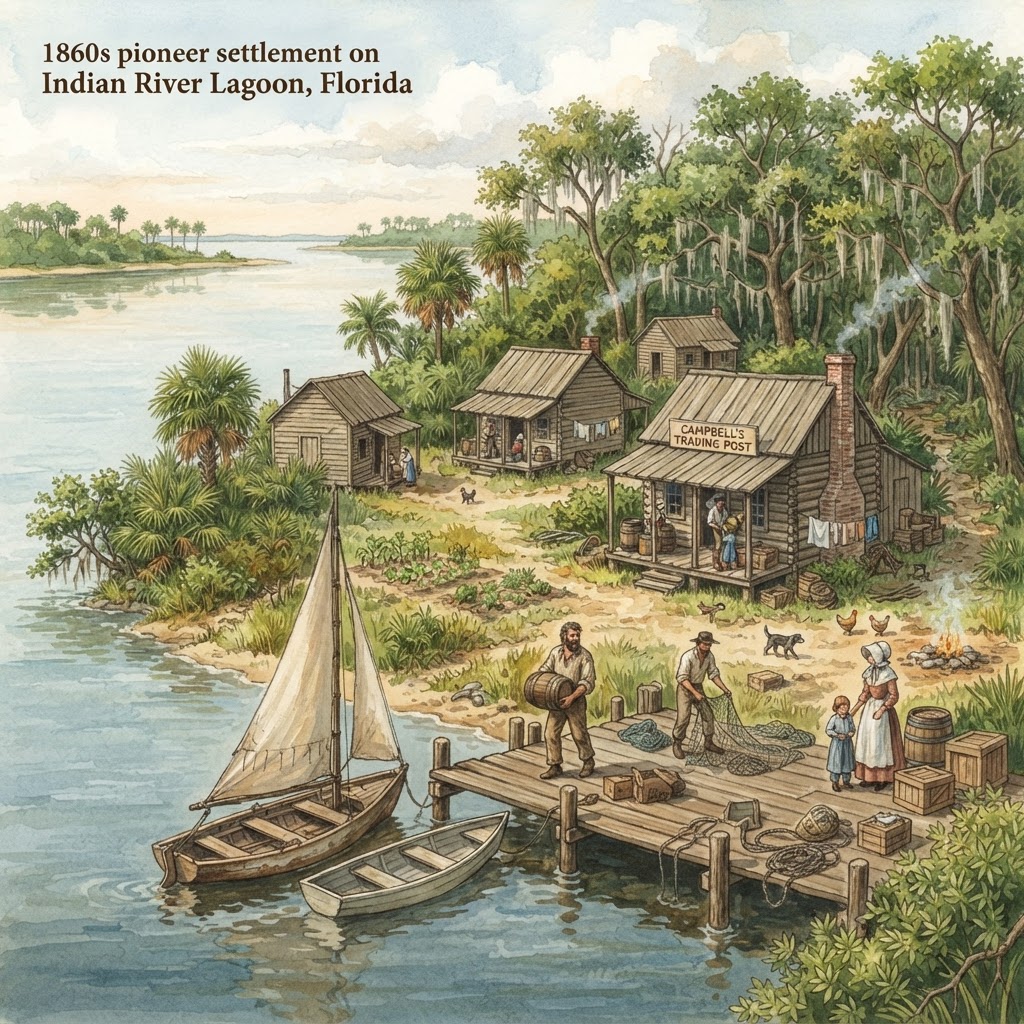
The Riverfront Settlement
The early settlement of Cocoa (1860s–1880s): The area we now call Cocoa Village was first settled in the 1860s, after Florida became a U.S. state and settlers began moving into the Indian River Lagoon corridor. The early settlers found a landscape of pine flatwoods, palmetto scrub, and oak hammocks along the lagoon's western shore. Life was hard and simple: The first settlers built rough wooden cabins near the lagoon, cleared small plots for farming, and fished the lagoon for food. There were no roads — the lagoon was the highway, and the only way to reach the outside world was by boat. A settlement grew up around a dock on the lagoon. Early names: The community went through several names in its early years. It was originally known as 'Indian River City' and later as 'St. Augustine Springs' before a event involving a shipment of cocoa (or cocoa beans) reportedly led to the name 'Cocoa.' The exact origin of the name is debated, but by the 1880s, the community was known as Cocoa. The early settlement was tiny — just a few families — but it had the three things that mattered on the frontier: a dock on the lagoon, fertile hammock land, and a location roughly halfway between Titusville and the growing settlements to the south. That location would prove important. The riverfront settlers grew vegetables, citrus, and pineapples, and they shipped their crops north by boat. It was a quiet, remote life — but the lagoon connected them to a wider world that was about to discover Florida.